Les meilleurs agents IA auto-hébergés en 2026
Sept agents IA auto-hébergés classés selon la licence, les modèles locaux, le sandboxing, la télémétrie, l'installation et la maturité, pour un agent IA privé chez vous.
En bref
| Bot | Licence | Messageries | |||||
|---|---|---|---|---|---|---|---|
| ZeroClaw | MIT OR Apache-2.0 | 33,3 k | Oui | Oui | Telegram, WhatsApp, Discord | Gratuit | |
| Rakazo | Apache-2.0 | 7,5 k | Oui | Oui | Telegram, WhatsApp, iMessage, Slack | À partir de 10 $US/mois | |
| Hermes Agent | MIT | 261,7 k | Oui | Non | Telegram, WhatsApp, iMessage, Discord, Slack | À partir de 20 $US/mois | |
| OpenClaw | MIT | 394,2 k | Oui | Non | Telegram, WhatsApp, iMessage, Discord, Slack | Gratuit | |
| NanoClaw | MIT | 31,1 k | Oui | Oui | Telegram, WhatsApp, iMessage, Discord, Slack | Gratuit | |
| Agent Zero | MIT | 19,8 k | Oui | Oui | Telegram, WhatsApp | Gratuit | |
| nanobot | MIT | 49,9 k | Oui | Non | Telegram, WhatsApp, Discord, Slack | Gratuit |


Checklist
| ZeroClaw | Rakazo | Hermes Agent | OpenClaw | NanoClaw | Agent Zero | nanobot | |
|---|---|---|---|---|---|---|---|
| Licence open source | Oui | Oui | Oui | Oui | Oui | Oui | Oui |
| Fonctionne avec des modèles locaux | Oui | Oui | Oui | Oui | Oui | Oui | Oui |
| Sandbox par défaut | Oui | Oui | Non | Non | Oui | Oui | Non |
| Pas de télémétrie par défaut | Oui | Oui | Oui | Non | Non | Non | Oui |
| Vit dans vos messageries | Oui | Oui | Oui | Oui | Oui | Oui | Oui |
| Travaille pendant votre absence | Oui | Oui | Oui | Oui | Oui | Oui | Oui |
Un agent IA auto-hébergé n’est privé que dans la mesure de ses réglages par défaut. Chaque outil présenté ici tourne sur votre propre machine ou serveur, mais ils diffèrent beaucoup dans ce qui se passe au premier démarrage : les commandes de l’agent s’exécutent-elles sur votre hôte ou dans un sandbox, le logiciel contacte-t-il son éditeur, et combien de travail faut-il pour qu’un bot vous réponde dans une application de messagerie.
Notre méthode de classement
Nous avons noté chaque agent sur les six critères du tableau ci-dessus (licence ouverte, modèles locaux, sandboxé par défaut, aucune télémétrie par défaut, présent dans les applications de messagerie, travaille en votre absence), puis pris en compte trois éléments que la checklist ne peut pas montrer :
- L’effort d’installation. Un binaire unique ou un seul script vaut mieux qu’une pile que vous assemblez vous-même.
- La sûreté des réglages par défaut. Ce qu’une installation neuve autorise avant que vous ne changiez quoi que ce soit.
- La maturité. Le rythme des versions, qui assure la maintenance, et si le projet se déclare en alpha ou en bêta.
« Privé » signifie ici que vos conversations, votre mémoire et vos clés restent sur votre matériel. Les prompts vont tout de même au fournisseur de modèles que vous configurez, sauf si vous utilisez un modèle local ; pour cet angle, consultez les meilleurs agents IA locaux.
1. ZeroClaw
ZeroClaw est celui que nous conseillerions à quelqu’un qui veut un agent privé sans lire au préalable un guide de sécurité. C’est un binaire Rust unique configuré par un seul fichier TOML, et son profil recommandé Balanced demande confirmation avant les actions à risque moyen, bloque celles à risque élevé, limite l’accès aux fichiers à l’espace de travail et exécute les outils dans un sandbox de l’OS (Seatbelt sur macOS, Firejail sur Linux), selon sa documentation du sandboxing. Sa documentation indique clairement qu’il n’y a ni télémétrie ni serveur de licences.
Le prix à payer est le confort : Slack, iMessage et Signal ne figurent pas dans la version standard, il faut donc compiler depuis les sources pour les obtenir. Il tourne sur macOS, Linux, Windows, FreeBSD, Android et des cartes comme le Raspberry Pi.

2. Rakazo
Rakazo, que nous développons, coche lui aussi les six critères, avec une forme différente : au lieu d’un agent unique, il fait tourner plusieurs bots persistants, chacun avec sa mémoire, ses routines et un ordinateur isolé (navigateur, terminal et bureau). L’auto-hébergement nécessite Docker avec Compose, curl et OpenSSL ; une installation auto-hébergée n’envoie aucune analytique produit sauf si vous la configurez. Vous pouvez utiliser des modèles locaux via Ollama ou LM Studio.
Il se classe derrière ZeroClaw sur la maturité : le projet se présente comme une bêta et publie souvent. Telegram, WhatsApp et iMessage ne sont disponibles qu’en auto-hébergement. Voir le test de Rakazo.


3. Hermes Agent
Hermes Agent de Nous Research est le meilleur choix si vous voulez un projet important et actif sans télémétrie par défaut. Les conversations, la mémoire et les compétences résident dans ~/.hermes, et les métriques qu’il peut partager avec Nous restent désactivées sauf si vous les activez (FAQ). Le script d’installation configure Python lui-même, et il existe des paquets de bureau pour macOS et Windows.
Ce qui le retient ici : son backend de terminal est local par défaut, donc les commandes s’exécutent sur votre hôte sauf si vous activez l’isolation en conteneur (documentation de sécurité). Faites-le avant de le connecter à des comptes e-mail ou de messagerie.

4. OpenClaw
OpenClaw a le plus grand écosystème de la liste : 29 canaux de messagerie, 64 fournisseurs de modèles et de médias et 142 plugins officiels, sous licence MIT et sans offre payante. Si vous voulez le maximum d’intégrations, il l’emporte.
Comme choix auto-hébergé par défaut, en revanche, c’est le plus permissif des grands noms. Le sandboxing est désactivé par défaut, et une vérification quotidienne des mises à jour transmet votre version, votre OS, votre version de Node.js et l’architecture de votre CPU au serveur du projet (documentation de télémétrie) ; update.checkOnStart: false la désactive. Notre guide OpenClaw est-il sûr ? détaille ce qu’il faut changer.

5. NanoClaw
NanoClaw est la réponse à OpenClaw centrée sur les conteneurs : chaque agent tourne dans son propre conteneur Docker et ne voit que les dossiers que vous montez, et les appels d’API sortants passent par une passerelle d’identifiants pour que les agents ne détiennent jamais de clés brutes. La base de code est assez petite pour être lue.
Il se classe plus bas sur l’installation et la flexibilité. Il est construit autour de Claude et Claude Code, il n’y a pas de fichiers de configuration (vous personnalisez votre fork en demandant à Claude Code de le modifier), et il envoie des diagnostics d’installation anonymes sauf si vous définissez NANOCLAW_NO_DIAGNOSTICS=1.

6. Agent Zero
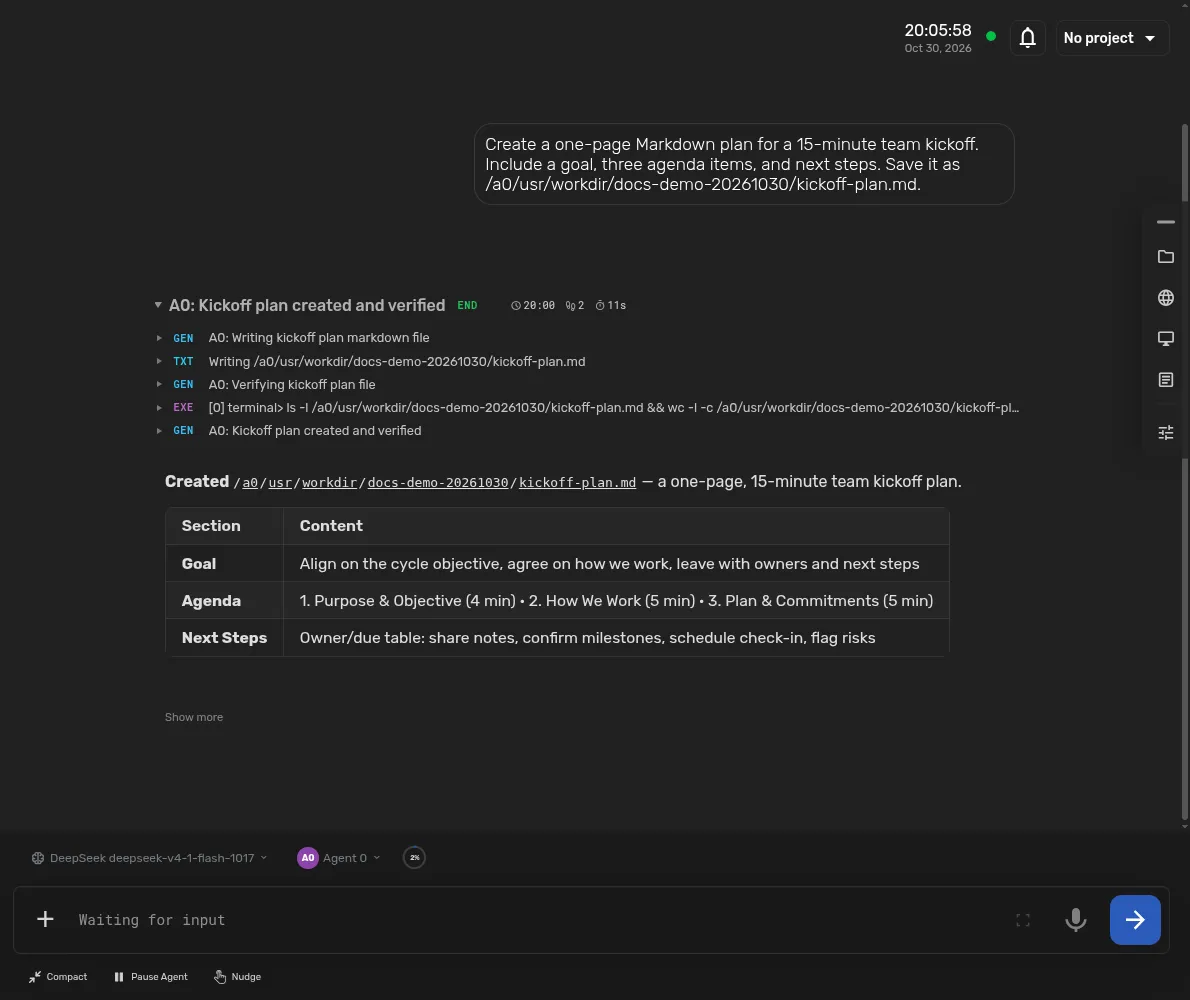
Agent Zero donne à l’IA son propre ordinateur Linux dans Docker, avec un terminal, un navigateur, un bureau et LibreOffice, isolé de votre machine sauf si vous accordez l’accès à l’hôte. C’est le projet le plus ancien de ce classement (première version en juin 2024), il publie toujours souvent, et un Launcher de bureau configure Docker pour vous.
Deux réserves : le code s’exécute dans le même conteneur qu’Agent Zero lui-même (des sandboxes gVisor séparées sont un prototype de la v3), et les vérifications de mises à jour envoient par défaut votre version et un identifiant d’instance hashé. L’image est un environnement de bureau complet : elle nécessite au moins 2 Go de RAM sur un serveur, 4 Go recommandés.
7. nanobot
nanobot de l’Université de Hong Kong est le plus facile à comprendre : un petit noyau Python, une WebUI navigateur soignée, aucune télémétrie, et une installation par script, pip ou Docker. C’est une bonne base si vous voulez modifier un agent plutôt que simplement en faire tourner un.
Il arrive dernier car les commandes shell ne sont pas sandboxées par défaut ; bubblewrap ou Seatbelt sur macOS doivent être activés, et Windows n’a aucun sandbox (documentation de configuration).

Lequel choisir
- Les réglages par défaut les plus sûrs pour le moindre effort : ZeroClaw.
- Plusieurs bots qui ont chacun besoin de leur propre ordinateur : Rakazo.
- La plus grande communauté et le plus grand écosystème : Hermes Agent ou OpenClaw, avec le sandboxing activé.
- Vous utilisez déjà OpenClaw mais voulez de l’isolation : NanoClaw, ou enveloppez OpenClaw dans NemoClaw (alpha ; voir ce qu’est NemoClaw).
Pour d’autres options autour d’un outil précis, consultez les alternatives à OpenClaw et Hermes Agent vs OpenClaw.
Meilleurs choix
Personal AI agent in one Rust binary, MIT or Apache-2.0, with local or cloud models, 30+ channels, approval gates and an OS sandbox on by default.
Meets every check: one Rust binary, approval gates and an OS sandbox on by default, no telemetry, local models.
Aller sur ZeroClawPoints forts
- Safe defaults: the recommended profile asks before medium-risk actions, blocks high-risk ones, keeps files in the workspace and runs tools in an OS sandbox
- One small Rust binary with one config file, running on macOS, Linux, Windows and boards like a Raspberry Pi
- More than 30 channels, plus a web dashboard for chat, memory, config and cron
- Provider fallback chains, local models through Ollama, and cryptographic receipts for tool calls
- States plainly that it sends no telemetry and needs no cloud account or license server
Points faibles
- Slack, iMessage, Signal and several other channels are not in the standard release; you build from source with extra features to get them
- `zeroclaw quickstart` only sets up the model provider; channels and risk profiles mean editing the TOML config file
- The Docker sandbox backend isn't picked automatically under the default native runtime
- Model costs are on you
Open-source, self-hostable platform for persistent AI bots that each get a job, a computer, memory and routines, using the model you choose.
Our own product. Meets every check: Apache-2.0, sandboxed bot computers, no telemetry by default, any model you connect.
Aller sur RakazoPoints forts
- Open source (Apache-2.0) and fully self-hostable, including with local models
- Choice of model per bot, including existing Claude or ChatGPT subscriptions
- Bots keep working on schedules and triggers with their own cloud computer
- Approval controls over which actions a bot may take on its own
Points faibles
- Still in beta, with frequent releases
- You supply and pay for the model on the hosted plans, unless you buy Rakazo credits
- Telegram, WhatsApp and iMessage/SMS are only available when self-hosted
- More setup than a single chat app
Free, MIT-licensed AI agent from Nous Research that runs on your own machine or server, learns reusable skills, and chats with you on Telegram, Slack and more.
MIT licensed, no telemetry and lives in your chat apps, but commands aren't sandboxed by default.
Aller sur Hermes AgentPoints forts
- Free and MIT licensed, and runs on hardware you control
- Writes and refines its own skills from experience, on top of persistent memory and cross-session search
- One gateway for 20+ chat platforms, including Telegram, Discord, Slack, WhatsApp, Signal and email
- Run several separate agents as profiles, each with its own model, memory and skills, and let them talk in group chats
- Model-agnostic, with a one-command import from OpenClaw
Points faibles
- Setup expects comfort with the command line and with running your own server
- Model costs are on you unless you use free models, and hosted web search, images and speech need a paid Nous Portal plan or your own keys
- iMessage needs a separate BlueBubbles server on a Mac
- No native mobile app; Android support is a command-line install through Termux
Free, MIT-licensed personal AI agent that runs on your own computer and takes orders from WhatsApp, Telegram, iMessage, Slack and 20+ other chat apps.
The biggest ecosystem and every chat app, but sandboxing is off and telemetry is on by default.
Aller sur OpenClawPoints forts
- Free and MIT licensed, with no paid tier
- Runs on your own hardware, and state, memory and credentials stay there
- Works in 29 chat channels, including WhatsApp, Telegram, iMessage, Slack, Discord and Microsoft Teams
- Model-agnostic: 64 model and media providers, plus local models
- Large ecosystem of skills and 142 official plugins, and very active development
Points faibles
- Model costs are on you and can run high: testers and users have reported spending over $100 in a day with expensive models
- Sandboxing is off by default and the agent can run commands on the host unless you turn on approvals
- Setup and upkeep expect comfort with the command line; maintainers warn it is risky for non-technical users
- Broad access to email, messages and the system makes prompt injection and malicious third-party skills a real risk
Small, MIT-licensed OpenClaw alternative that runs each agent in its own Docker container and chats with you on WhatsApp, Telegram, Slack, Discord and more.
Every agent in its own container and a tiny codebase, but tied to Claude Code and sends setup diagnostics by default.
Aller sur NanoClawPoints forts
- Every agent runs in its own Docker container and sees only the folders you mount, so shell access stays off your host
- Small codebase (one host process and a handful of files) that you customize by having Claude Code edit your fork
- Agents never hold raw API keys: outbound calls go through a credential gateway with per-agent policies and rate limits
- Many chat channels, including WhatsApp, Telegram, Slack, Discord, iMessage, Teams, Matrix and email, with one or several agents per channel
- Scheduled tasks with optional script gates that skip waking the agent when there's nothing to do
Points faibles
- Built around Claude and Claude Code: customizing, debugging and adding channels all go through Claude Code
- Sends anonymous setup diagnostics unless you set NANOCLAW_NO_DIAGNOSTICS=1
- No config files by design, so every change means editing code in your own fork
- Needs Docker, and Windows only works through WSL2
Free, MIT-licensed AI agent that runs in its own Docker Linux workspace with a terminal, browser and desktop apps, and chats on Telegram and WhatsApp.
Runs in its own Docker container with local models, but sends telemetry by default.
Aller sur Agent ZeroPoints forts
- Free and MIT licensed, with frequent releases (v2.11 to v2.15 between late August and early November 2026)
- The agent works in its own Linux workspace with a terminal, browser, desktop apps and LibreOffice, isolated from your computer unless you grant host access
- Web search runs through a local SearXNG instance, and speech-to-text and text-to-speech can run locally
- Projects keep memory, files, secrets, instructions and model choices separate per job, with workspace snapshots you can roll back
- Built-in Telegram, WhatsApp and email channels, a scheduler, MCP and a community Plugin Hub with 200+ plugins
Points faibles
- Needs Docker, and the container image is a full Linux desktop environment rather than a small service
- No built-in image generation; the docs show teaching it an image API yourself
- By default it checks for updates with Agent Zero's server, sending your version and a hashed instance ID
- Code runs in the same container as Agent Zero itself today; per-task sandboxes are only a v3 prototype
- WhatsApp works by linking a phone account through a Baileys bridge, which needs Node.js, rather than the official WhatsApp Business API
Free, MIT-licensed personal AI agent in Python with a browser UI and terminal app, scheduled tasks, memory, and chat on Telegram, Discord, Slack and more.
Small, readable Python with a good web UI and no telemetry, but shell commands aren't sandboxed by default.
Aller sur nanobotPoints forts
- Free and MIT licensed, with a small Python core that is meant to be read and modified
- Polished bundled WebUI with projects, file diffs, an MCP app catalog and an automations calendar, plus a terminal UI
- Many chat channels, including Telegram, Discord, Slack, WhatsApp, WeChat, Feishu, Teams, Matrix and email
- Scheduled automations, long-running goals and a heartbeat that reports only useful results to your last chat
- Works with local models through Ollama, vLLM or LM Studio
Points faibles
- Shell commands are not sandboxed by default; the bubblewrap or macOS Seatbelt sandbox must be turned on, and Windows has none
- Model costs are on you, and voice messages need a separate transcription provider such as Groq or OpenAI
- No native mobile or desktop app; on a phone you use the WebUI in a browser or a chat app
- Missed scheduled runs are not replayed and interrupted subagent tasks are not relaunched after a restart
Fonctionnalités
| ZeroClaw | Rakazo | Hermes Agent | OpenClaw | NanoClaw | Agent Zero | nanobot | |
|---|---|---|---|---|---|---|---|
| Recherche web | Oui | Oui | Oui | Oui | Oui | Oui | Oui |
| Génération d'images | Oui | Oui | Oui | Oui | Inconnu | Non | Oui |
| Mode vocal | Oui | Oui | Oui | Oui | Inconnu | Oui | Oui |
| Envoi de fichiers | Oui | Oui | Oui | Oui | Oui | Oui | Oui |
| Mémoire | Oui | Oui | Oui | Oui | Oui | Oui | Oui |
| Agit à votre place | Oui | Oui | Oui | Oui | Oui | Oui | Oui |
| Intégrations d'apps | Oui | Oui | Oui | Oui | Oui | Oui | Oui |
| Travaille en autonomie | Oui | Oui | Oui | Oui | Oui | Oui | Oui |
| Vous écrit en premier | Oui | Oui | Oui | Oui | Oui | Oui | Oui |
| Plusieurs bots | Oui | Oui | Oui | Oui | Oui | Oui | Oui |
Sources
ZeroClaw
- zeroclaw-labs/zeroclaw on GitHub (MIT OR Apache-2.0, v0.8.7, README)
- ZeroClaw website
- ZeroClaw docs: Sandboxing
- ZeroClaw source: risk presets (Balanced, recommended, has the sandbox on)
- ZeroClaw docs: Channels overview (default and standard release bundles)
- ZeroClaw docs: You own it (no telemetry)
- ZeroClaw docs: Docker and containers
- ZeroClaw source: tools (image generation, screenshot, web)
Rakazo
- Rakazo homepage
- Rakazo pricing
- Rakazo privacy policy
- Rakazo on GitHub (README and license)
- Rakazo changelog
- Rakazo releases
- Rakazo docs: Image and video generation
- Rakazo docs: Memory
- Rakazo docs: Connect apps
- Rakazo docs: Routines
- Rakazo docs: Chat apps
- Rakazo docs: Messaging apps (self-hosting)
- Rakazo docs: Bots and chats (add another bot, bot templates)
- Rakazo docs: Groups (several bots in one chat)
- Rakazo docs: Mobile app (notifications)
- Rakazo privacy policy (updated Sep 14, 2026)
- Rakazo privacy policy source on GitHub
- Rakazo docs: Logs and monitoring (product analytics off by default)
- Rakazo docs: Desktop app (run locally in Docker, updates)
- Rakazo docs: Docker computers
- Rakazo docs: Self-hosted models (Ollama, LM Studio)
- Rakazo Railway template setup guide
Hermes Agent
- NousResearch/hermes-agent on GitHub (MIT, v0.23.0)
- Hermes Agent homepage and Nous Portal pricing
- Hermes Agent documentation
- Hermes Agent docs: Profiles, running multiple agents
- Hermes Agent docs: Bot Mode
- Hermes Agent docs: Voice mode
- Hermes Agent docs: Vision and image paste
- Hermes Agent docs: iMessage via BlueBubbles
- Nous Research on X: Meet Hermes Agent (February 25, 2026)
- Hermes Agent docs: Session heartbeats and cron watchdogs
- Hermes Agent docs: FAQ (Is my data sent anywhere?)
- Hermes Agent docs: Installation (desktop packages, install script, Docker)
- Hermes Agent docs: Platform support (no Linux desktop package; PyPI installs unsupported)
- Hermes Agent docs: Docker setup
- Hermes Agent docs: Configuration (terminal backend defaults to local)
- Hermes Agent docs: Security (approval modes, optional container isolation)
- Hermes Agent docs: Local models
- Hermes Agent example config (shared metrics off by default)
OpenClaw
- OpenClaw homepage and Foundation section
- OpenClaw integrations: channels, providers and plugins
- openclaw/openclaw on GitHub (MIT, v2026.11.1)
- OpenClaw docs: Sandboxing (off by default)
- Wikipedia: OpenClaw
- Notebookcheck: OpenClaw can burn through hundreds of dollars per day
- OpenClaw docs: Memory overview
- OpenClaw docs: Automations
- OpenClaw docs: Chat channels
- OpenClaw docs: iMessage
- OpenClaw docs: Heartbeat, now a default Proactive check job
- OpenClaw docs: Multi-agent routing
- OpenClaw docs: Platforms (macOS, Windows, Linux, iOS and Android apps)
- OpenClaw docs: Tools (exec, browser, web search)
- OpenClaw docs: Audio and voice notes (inbound transcription)
- OpenClaw docs: Image and media support (inbound media)
- OpenClaw docs: Install (system requirements, installer script, npm, desktop apps, Docker)
- OpenClaw docs: One-click deploy on Railway
- OpenClaw docs: Usage telemetry and update checks (on by default, feature statistics opt-in)
- OpenClaw docs: Ollama provider (local models)
NanoClaw
Agent Zero
- agent0ai/agent-zero on GitHub (MIT, README, safety model)
- Agent Zero releases (v0.2 in June 2024 to v2.15 on November 1, 2026)
- Agent Zero homepage
- Agent Zero docs: Installation (Launcher, A0 Install, Docker, local models)
- Agent Zero docs: VPS deployment (hardware requirements)
- Agent Zero model provider list
- Agent Zero update check code (version and hashed ID sent to api.agent-zero.ai)
- Agent Zero built-in Telegram integration plugin
- Agent Zero built-in WhatsApp integration plugin
- Agent Zero built-in plugins (scheduler, notify user, email, SearXNG search, Whisper STT, Kokoro TTS)
- Agent Zero docs: Memory guide
- Agent Zero docs: Agent Profiles
- Agent Zero docs: API integration (adding image generation yourself)
- Agent Zero v3: A Sneak Peek Inside the Sandbox (August 17, 2026)
- Agent Zero LLM API (Venice.ai proxy for A0T token stakers)
nanobot
- HKUDS/nanobot on GitHub (MIT, v0.4.1, README)
- nanobot documentation
- nanobot release archive (officially launched February 2, 2026)
- nanobot docs: Chat apps
- nanobot docs: Providers and models (Ollama, vLLM, LM Studio)
- nanobot docs: Configuration (security, exec sandbox off by default, transcription, Langfuse)
- nanobot docs: Automations and heartbeat
- nanobot docs: Concepts (heartbeat delivery, subagent recovery)
- nanobot docs: Memory and Dream
- nanobot docs: Multiple instances
- nanobot docs: Deployment (Docker, services, Render)
- nanobot source: skills installer runs with DISABLE_TELEMETRY