Лучшие self-hosted AI-агенты в 2026 году
Семь self-hosted AI-агентов: лицензия, локальные модели, песочница, телеметрия, сложность установки и зрелость — для приватного AI-агента на своём железе.
Коротко
| Бот | Лицензия | Мессенджеры | |||||
|---|---|---|---|---|---|---|---|
| ZeroClaw | MIT OR Apache-2.0 | 33,3 тыс. | Да | Да | Telegram, WhatsApp, Discord | Бесплатно | |
| Rakazo | Apache-2.0 | 7,5 тыс. | Да | Да | Telegram, WhatsApp, iMessage, Slack | От 10 $/мес. | |
| Hermes Agent | MIT | 261,7 тыс. | Да | Нет | Telegram, WhatsApp, iMessage, Discord, Slack | От 20 $/мес. | |
| OpenClaw | MIT | 394,2 тыс. | Да | Нет | Telegram, WhatsApp, iMessage, Discord, Slack | Бесплатно | |
| NanoClaw | MIT | 31,1 тыс. | Да | Да | Telegram, WhatsApp, iMessage, Discord, Slack | Бесплатно | |
| Agent Zero | MIT | 19,8 тыс. | Да | Да | Telegram, WhatsApp | Бесплатно | |
| nanobot | MIT | 49,9 тыс. | Да | Нет | Telegram, WhatsApp, Discord, Slack | Бесплатно |


Чек-лист
| ZeroClaw | Rakazo | Hermes Agent | OpenClaw | NanoClaw | Agent Zero | nanobot | |
|---|---|---|---|---|---|---|---|
| Открытая лицензия | Да | Да | Да | Да | Да | Да | Да |
| Работает с локальными моделями | Да | Да | Да | Да | Да | Да | Да |
| Песочница по умолчанию | Да | Да | Нет | Нет | Да | Да | Нет |
| Без телеметрии по умолчанию | Да | Да | Да | Нет | Нет | Нет | Да |
| Живёт в ваших мессенджерах | Да | Да | Да | Да | Да | Да | Да |
| Работает, пока вас нет | Да | Да | Да | Да | Да | Да | Да |
Self-hosted AI-агент приватен ровно настолько, насколько приватны его настройки по умолчанию. Каждый инструмент здесь работает на вашей машине или сервере, но они сильно различаются тем, что происходит при первом запуске: выполняются ли команды агента на хосте или в песочнице, отправляет ли ПО данные «домой» и сколько усилий нужно, чтобы бот начал отвечать вам в чат-приложении.
Как мы составляли рейтинг
Мы оценили каждого агента по шести проверкам из таблицы выше (открытая лицензия, локальные модели, песочница по умолчанию, отсутствие телеметрии по умолчанию, работа в чат-приложениях, работа в ваше отсутствие), а затем учли три вещи, которые чек-лист не показывает:
- Сложность установки. Единый бинарник или один скрипт лучше стека, который вы собираете сами.
- Безопасность настроек по умолчанию. Что разрешает свежая установка, пока вы ничего не изменили.
- Зрелость. Темп релизов, кто поддерживает проект и называет ли он себя alpha или beta.
«Приватный» здесь означает, что ваши разговоры, память и ключи остаются на вашем железе. Промпты всё равно уходят тому провайдеру моделей, которого вы настроили, если только вы не запускаете локальную модель; об этом см. лучшие локальные AI-агенты.
1. ZeroClaw
ZeroClaw — тот, кого мы порекомендовали бы человеку, которому нужен приватный агент без предварительного чтения руководства по безопасности. Это один бинарный файл на Rust, настраиваемый одним файлом TOML, и его рекомендуемый профиль Balanced спрашивает разрешения перед действиями среднего риска, блокирует действия высокого риска, ограничивает доступ к файлам рабочей папкой и запускает инструменты в песочнице ОС (Seatbelt на macOS, Firejail на Linux), согласно документации по песочнице. Его документация прямо заявляет, что нет ни телеметрии, ни сервера лицензий.
Цена — удобство: Slack, iMessage и Signal не входят в стандартный релиз, и чтобы их получить, нужно собирать из исходников. Он работает на macOS, Linux, Windows, FreeBSD, Android и платах вроде Raspberry Pi.

2. Rakazo
Rakazo, который делаем мы, тоже проходит все шесть проверок, но устроен иначе: вместо одного агента он запускает несколько постоянных ботов, у каждого из которых своя память, рутины и изолированный компьютер (браузер, терминал и рабочий стол). Для self-hosting нужны Docker с Compose, curl и OpenSSL; self-hosted установка не отправляет продуктовую аналитику, если вы её не настроите. Можно использовать локальные модели через Ollama или LM Studio.
По зрелости он уступает ZeroClaw: проект называет себя beta и часто выпускает релизы. Telegram, WhatsApp и iMessage доступны только при self-hosting. См. обзор Rakazo.


3. Hermes Agent
Hermes Agent от Nous Research — самый сильный выбор, если вам нужен большой активный проект без телеметрии по умолчанию. Разговоры, память и навыки хранятся в ~/.hermes, а метрики, которыми он может делиться с Nous, остаются выключенными, пока вы не дадите согласие (FAQ). Скрипт установки сам настраивает Python, а для macOS и Windows есть десктопные пакеты.
Что его здесь сдерживает: терминальный бэкенд по умолчанию локальный, поэтому команды выполняются на вашем хосте, пока вы не включите изоляцию в контейнере (документация по безопасности). Сделайте это до подключения почты или чат-аккаунтов.

4. OpenClaw
OpenClaw обладает крупнейшей экосистемой в списке: 29 чат-каналов, 64 провайдера моделей и медиа и 142 официальных плагина, лицензия MIT без платного тарифа. Если вам нужно больше всего интеграций, он побеждает.
Однако как self-hosted решение по умолчанию он самый «расслабленный» из крупных имён. Песочница выключена по умолчанию, а ежедневная проверка обновлений сообщает серверу проекта вашу версию, ОС, версию Node.js и архитектуру CPU (документация по телеметрии); update.checkOnStart: false это отключает. Наше руководство Безопасен ли OpenClaw? рассказывает, что изменить.

5. NanoClaw
NanoClaw — ответ OpenClaw в стиле «контейнеры прежде всего»: каждый агент работает в собственном Docker-контейнере и видит только смонтированные вами папки, а исходящие API-вызовы идут через шлюз учётных данных, так что агенты никогда не держат «сырые» ключи. Кодовая база достаточно мала, чтобы её прочитать.
По установке и гибкости он ниже. Он построен вокруг Claude и Claude Code, конфигурационных файлов нет (вы настраиваете свой форк, прося Claude Code его отредактировать), и он отправляет анонимную диагностику установки, если не задать NANOCLAW_NO_DIAGNOSTICS=1.

6. Agent Zero
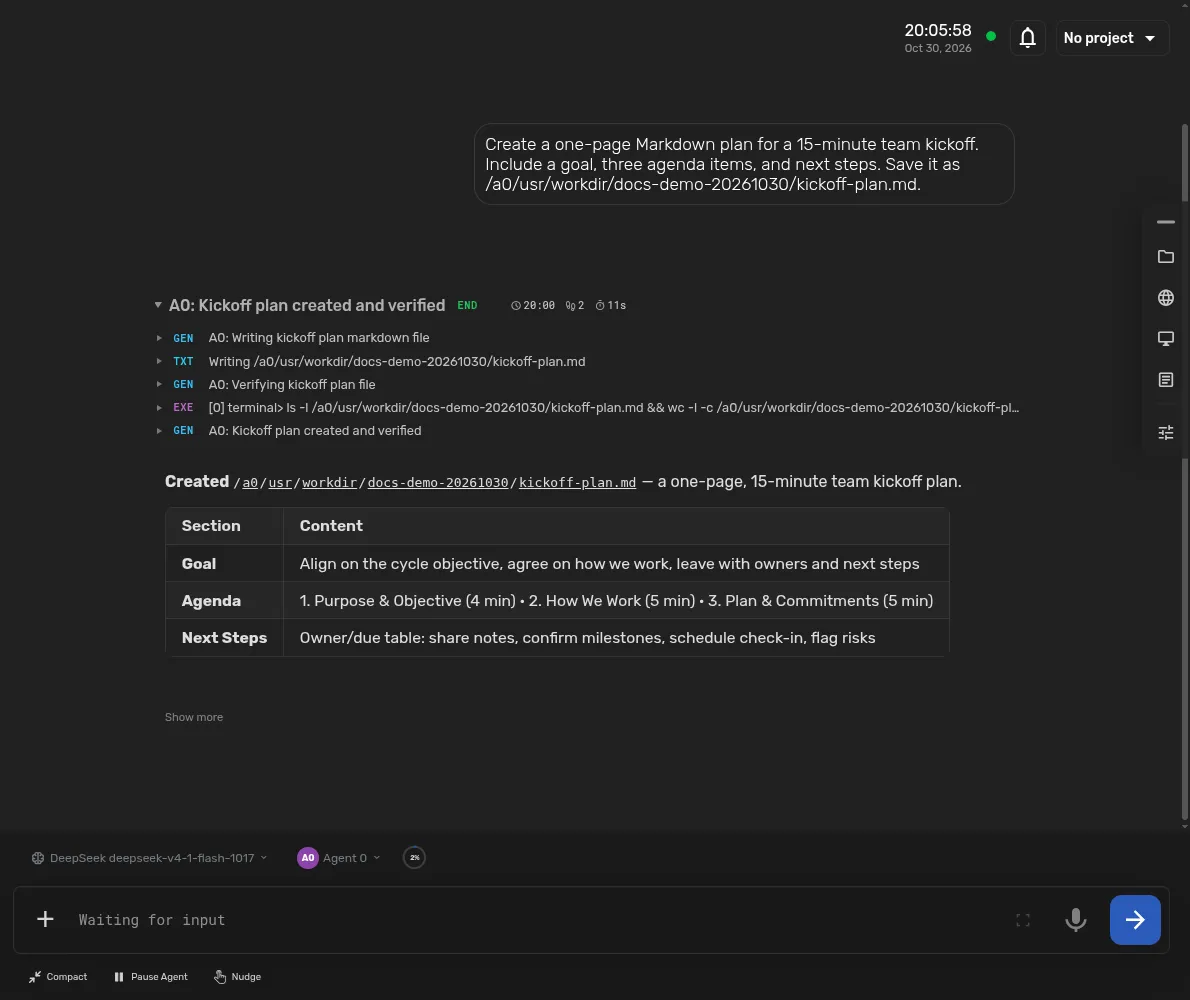
Agent Zero даёт AI собственный Linux-компьютер в Docker с терминалом, браузером, рабочим столом и LibreOffice, изолированный от вашей машины, если вы не предоставите доступ к хосту. Это самый старый проект в рейтинге (первый релиз в июне 2024 года), он по-прежнему часто выпускает релизы, а десктопный Launcher настраивает Docker за вас.
Две оговорки: код выполняется в том же контейнере, что и сам Agent Zero (отдельные песочницы gVisor — это прототип v3), а проверки обновлений по умолчанию отправляют вашу версию и хешированный ID инстанса. Образ — это полноценное рабочее окружение, поэтому на сервере нужно не меньше 2 ГБ RAM, рекомендуется 4 ГБ.
7. nanobot
nanobot от Гонконгского университета понять проще всего: небольшое ядро на Python, отполированный браузерный WebUI, никакой телеметрии и установка через скрипт, pip или Docker. Это хорошая основа, если вы хотите дорабатывать агента, а не просто запускать его.
Он на последнем месте, потому что shell-команды по умолчанию не изолируются; bubblewrap или macOS Seatbelt нужно включать вручную, а в Windows песочницы нет вовсе (документация по конфигурации).

Что выбрать
- Самые безопасные настройки по умолчанию при минимуме усилий: ZeroClaw.
- Несколько ботов, каждому из которых нужен свой компьютер: Rakazo.
- Крупнейшее сообщество и экосистема: Hermes Agent или OpenClaw с включённой песочницей.
- Уже используете OpenClaw, но хотите изоляции: NanoClaw, или оберните OpenClaw в NemoClaw (alpha; см. что такое NemoClaw).
Больше вариантов вокруг одного инструмента — в статьях альтернативы OpenClaw и Hermes Agent vs OpenClaw.
Лучшие подборки
Personal AI agent in one Rust binary, MIT or Apache-2.0, with local or cloud models, 30+ channels, approval gates and an OS sandbox on by default.
Meets every check: one Rust binary, approval gates and an OS sandbox on by default, no telemetry, local models.
Открыть ZeroClawСильные стороны
- Safe defaults: the recommended profile asks before medium-risk actions, blocks high-risk ones, keeps files in the workspace and runs tools in an OS sandbox
- One small Rust binary with one config file, running on macOS, Linux, Windows and boards like a Raspberry Pi
- More than 30 channels, plus a web dashboard for chat, memory, config and cron
- Provider fallback chains, local models through Ollama, and cryptographic receipts for tool calls
- States plainly that it sends no telemetry and needs no cloud account or license server
Слабые стороны
- Slack, iMessage, Signal and several other channels are not in the standard release; you build from source with extra features to get them
- `zeroclaw quickstart` only sets up the model provider; channels and risk profiles mean editing the TOML config file
- The Docker sandbox backend isn't picked automatically under the default native runtime
- Model costs are on you
Open-source, self-hostable platform for persistent AI bots that each get a job, a computer, memory and routines, using the model you choose.
Our own product. Meets every check: Apache-2.0, sandboxed bot computers, no telemetry by default, any model you connect.
Открыть RakazoСильные стороны
- Open source (Apache-2.0) and fully self-hostable, including with local models
- Choice of model per bot, including existing Claude or ChatGPT subscriptions
- Bots keep working on schedules and triggers with their own cloud computer
- Approval controls over which actions a bot may take on its own
Слабые стороны
- Still in beta, with frequent releases
- You supply and pay for the model on the hosted plans, unless you buy Rakazo credits
- Telegram, WhatsApp and iMessage/SMS are only available when self-hosted
- More setup than a single chat app
Free, MIT-licensed AI agent from Nous Research that runs on your own machine or server, learns reusable skills, and chats with you on Telegram, Slack and more.
MIT licensed, no telemetry and lives in your chat apps, but commands aren't sandboxed by default.
Открыть Hermes AgentСильные стороны
- Free and MIT licensed, and runs on hardware you control
- Writes and refines its own skills from experience, on top of persistent memory and cross-session search
- One gateway for 20+ chat platforms, including Telegram, Discord, Slack, WhatsApp, Signal and email
- Run several separate agents as profiles, each with its own model, memory and skills, and let them talk in group chats
- Model-agnostic, with a one-command import from OpenClaw
Слабые стороны
- Setup expects comfort with the command line and with running your own server
- Model costs are on you unless you use free models, and hosted web search, images and speech need a paid Nous Portal plan or your own keys
- iMessage needs a separate BlueBubbles server on a Mac
- No native mobile app; Android support is a command-line install through Termux
Free, MIT-licensed personal AI agent that runs on your own computer and takes orders from WhatsApp, Telegram, iMessage, Slack and 20+ other chat apps.
The biggest ecosystem and every chat app, but sandboxing is off and telemetry is on by default.
Открыть OpenClawСильные стороны
- Free and MIT licensed, with no paid tier
- Runs on your own hardware, and state, memory and credentials stay there
- Works in 29 chat channels, including WhatsApp, Telegram, iMessage, Slack, Discord and Microsoft Teams
- Model-agnostic: 64 model and media providers, plus local models
- Large ecosystem of skills and 142 official plugins, and very active development
Слабые стороны
- Model costs are on you and can run high: testers and users have reported spending over $100 in a day with expensive models
- Sandboxing is off by default and the agent can run commands on the host unless you turn on approvals
- Setup and upkeep expect comfort with the command line; maintainers warn it is risky for non-technical users
- Broad access to email, messages and the system makes prompt injection and malicious third-party skills a real risk
Small, MIT-licensed OpenClaw alternative that runs each agent in its own Docker container and chats with you on WhatsApp, Telegram, Slack, Discord and more.
Every agent in its own container and a tiny codebase, but tied to Claude Code and sends setup diagnostics by default.
Открыть NanoClawСильные стороны
- Every agent runs in its own Docker container and sees only the folders you mount, so shell access stays off your host
- Small codebase (one host process and a handful of files) that you customize by having Claude Code edit your fork
- Agents never hold raw API keys: outbound calls go through a credential gateway with per-agent policies and rate limits
- Many chat channels, including WhatsApp, Telegram, Slack, Discord, iMessage, Teams, Matrix and email, with one or several agents per channel
- Scheduled tasks with optional script gates that skip waking the agent when there's nothing to do
Слабые стороны
- Built around Claude and Claude Code: customizing, debugging and adding channels all go through Claude Code
- Sends anonymous setup diagnostics unless you set NANOCLAW_NO_DIAGNOSTICS=1
- No config files by design, so every change means editing code in your own fork
- Needs Docker, and Windows only works through WSL2
Free, MIT-licensed AI agent that runs in its own Docker Linux workspace with a terminal, browser and desktop apps, and chats on Telegram and WhatsApp.
Runs in its own Docker container with local models, but sends telemetry by default.
Открыть Agent ZeroСильные стороны
- Free and MIT licensed, with frequent releases (v2.11 to v2.15 between late August and early November 2026)
- The agent works in its own Linux workspace with a terminal, browser, desktop apps and LibreOffice, isolated from your computer unless you grant host access
- Web search runs through a local SearXNG instance, and speech-to-text and text-to-speech can run locally
- Projects keep memory, files, secrets, instructions and model choices separate per job, with workspace snapshots you can roll back
- Built-in Telegram, WhatsApp and email channels, a scheduler, MCP and a community Plugin Hub with 200+ plugins
Слабые стороны
- Needs Docker, and the container image is a full Linux desktop environment rather than a small service
- No built-in image generation; the docs show teaching it an image API yourself
- By default it checks for updates with Agent Zero's server, sending your version and a hashed instance ID
- Code runs in the same container as Agent Zero itself today; per-task sandboxes are only a v3 prototype
- WhatsApp works by linking a phone account through a Baileys bridge, which needs Node.js, rather than the official WhatsApp Business API
Free, MIT-licensed personal AI agent in Python with a browser UI and terminal app, scheduled tasks, memory, and chat on Telegram, Discord, Slack and more.
Small, readable Python with a good web UI and no telemetry, but shell commands aren't sandboxed by default.
Открыть nanobotСильные стороны
- Free and MIT licensed, with a small Python core that is meant to be read and modified
- Polished bundled WebUI with projects, file diffs, an MCP app catalog and an automations calendar, plus a terminal UI
- Many chat channels, including Telegram, Discord, Slack, WhatsApp, WeChat, Feishu, Teams, Matrix and email
- Scheduled automations, long-running goals and a heartbeat that reports only useful results to your last chat
- Works with local models through Ollama, vLLM or LM Studio
Слабые стороны
- Shell commands are not sandboxed by default; the bubblewrap or macOS Seatbelt sandbox must be turned on, and Windows has none
- Model costs are on you, and voice messages need a separate transcription provider such as Groq or OpenAI
- No native mobile or desktop app; on a phone you use the WebUI in a browser or a chat app
- Missed scheduled runs are not replayed and interrupted subagent tasks are not relaunched after a restart
Функции
| ZeroClaw | Rakazo | Hermes Agent | OpenClaw | NanoClaw | Agent Zero | nanobot | |
|---|---|---|---|---|---|---|---|
| Поиск в интернете | Да | Да | Да | Да | Да | Да | Да |
| Генерация изображений | Да | Да | Да | Да | Неизвестно | Нет | Да |
| Голосовой режим | Да | Да | Да | Да | Неизвестно | Да | Да |
| Загрузка файлов | Да | Да | Да | Да | Да | Да | Да |
| Память | Да | Да | Да | Да | Да | Да | Да |
| Выполняет действия за вас | Да | Да | Да | Да | Да | Да | Да |
| Интеграции с приложениями | Да | Да | Да | Да | Да | Да | Да |
| Работает самостоятельно | Да | Да | Да | Да | Да | Да | Да |
| Пишет первым | Да | Да | Да | Да | Да | Да | Да |
| Несколько ботов | Да | Да | Да | Да | Да | Да | Да |
Источники
ZeroClaw
- zeroclaw-labs/zeroclaw on GitHub (MIT OR Apache-2.0, v0.8.7, README)
- ZeroClaw website
- ZeroClaw docs: Sandboxing
- ZeroClaw source: risk presets (Balanced, recommended, has the sandbox on)
- ZeroClaw docs: Channels overview (default and standard release bundles)
- ZeroClaw docs: You own it (no telemetry)
- ZeroClaw docs: Docker and containers
- ZeroClaw source: tools (image generation, screenshot, web)
Rakazo
- Rakazo homepage
- Rakazo pricing
- Rakazo privacy policy
- Rakazo on GitHub (README and license)
- Rakazo changelog
- Rakazo releases
- Rakazo docs: Image and video generation
- Rakazo docs: Memory
- Rakazo docs: Connect apps
- Rakazo docs: Routines
- Rakazo docs: Chat apps
- Rakazo docs: Messaging apps (self-hosting)
- Rakazo docs: Bots and chats (add another bot, bot templates)
- Rakazo docs: Groups (several bots in one chat)
- Rakazo docs: Mobile app (notifications)
- Rakazo privacy policy (updated Sep 14, 2026)
- Rakazo privacy policy source on GitHub
- Rakazo docs: Logs and monitoring (product analytics off by default)
- Rakazo docs: Desktop app (run locally in Docker, updates)
- Rakazo docs: Docker computers
- Rakazo docs: Self-hosted models (Ollama, LM Studio)
- Rakazo Railway template setup guide
Hermes Agent
- NousResearch/hermes-agent on GitHub (MIT, v0.23.0)
- Hermes Agent homepage and Nous Portal pricing
- Hermes Agent documentation
- Hermes Agent docs: Profiles, running multiple agents
- Hermes Agent docs: Bot Mode
- Hermes Agent docs: Voice mode
- Hermes Agent docs: Vision and image paste
- Hermes Agent docs: iMessage via BlueBubbles
- Nous Research on X: Meet Hermes Agent (February 25, 2026)
- Hermes Agent docs: Session heartbeats and cron watchdogs
- Hermes Agent docs: FAQ (Is my data sent anywhere?)
- Hermes Agent docs: Installation (desktop packages, install script, Docker)
- Hermes Agent docs: Platform support (no Linux desktop package; PyPI installs unsupported)
- Hermes Agent docs: Docker setup
- Hermes Agent docs: Configuration (terminal backend defaults to local)
- Hermes Agent docs: Security (approval modes, optional container isolation)
- Hermes Agent docs: Local models
- Hermes Agent example config (shared metrics off by default)
OpenClaw
- OpenClaw homepage and Foundation section
- OpenClaw integrations: channels, providers and plugins
- openclaw/openclaw on GitHub (MIT, v2026.11.1)
- OpenClaw docs: Sandboxing (off by default)
- Wikipedia: OpenClaw
- Notebookcheck: OpenClaw can burn through hundreds of dollars per day
- OpenClaw docs: Memory overview
- OpenClaw docs: Automations
- OpenClaw docs: Chat channels
- OpenClaw docs: iMessage
- OpenClaw docs: Heartbeat, now a default Proactive check job
- OpenClaw docs: Multi-agent routing
- OpenClaw docs: Platforms (macOS, Windows, Linux, iOS and Android apps)
- OpenClaw docs: Tools (exec, browser, web search)
- OpenClaw docs: Audio and voice notes (inbound transcription)
- OpenClaw docs: Image and media support (inbound media)
- OpenClaw docs: Install (system requirements, installer script, npm, desktop apps, Docker)
- OpenClaw docs: One-click deploy on Railway
- OpenClaw docs: Usage telemetry and update checks (on by default, feature statistics opt-in)
- OpenClaw docs: Ollama provider (local models)
NanoClaw
Agent Zero
- agent0ai/agent-zero on GitHub (MIT, README, safety model)
- Agent Zero releases (v0.2 in June 2024 to v2.15 on November 1, 2026)
- Agent Zero homepage
- Agent Zero docs: Installation (Launcher, A0 Install, Docker, local models)
- Agent Zero docs: VPS deployment (hardware requirements)
- Agent Zero model provider list
- Agent Zero update check code (version and hashed ID sent to api.agent-zero.ai)
- Agent Zero built-in Telegram integration plugin
- Agent Zero built-in WhatsApp integration plugin
- Agent Zero built-in plugins (scheduler, notify user, email, SearXNG search, Whisper STT, Kokoro TTS)
- Agent Zero docs: Memory guide
- Agent Zero docs: Agent Profiles
- Agent Zero docs: API integration (adding image generation yourself)
- Agent Zero v3: A Sneak Peek Inside the Sandbox (August 17, 2026)
- Agent Zero LLM API (Venice.ai proxy for A0T token stakers)
nanobot
- HKUDS/nanobot on GitHub (MIT, v0.4.1, README)
- nanobot documentation
- nanobot release archive (officially launched February 2, 2026)
- nanobot docs: Chat apps
- nanobot docs: Providers and models (Ollama, vLLM, LM Studio)
- nanobot docs: Configuration (security, exec sandbox off by default, transcription, Langfuse)
- nanobot docs: Automations and heartbeat
- nanobot docs: Concepts (heartbeat delivery, subagent recovery)
- nanobot docs: Memory and Dream
- nanobot docs: Multiple instances
- nanobot docs: Deployment (Docker, services, Render)
- nanobot source: skills installer runs with DISABLE_TELEMETRY