Die besten Open-Source-KI-Agenten und persönlichen KI-Assistenten
Sieben Open-Source-KI-Agenten im Vergleich: Lizenz, Community, Reife und wie offen sie wirklich sind – von OpenClaw und Hermes Agent bis zu kleinen, lesbaren Codebasen.
Auf einen Blick
| Bot | Lizenz | Chat-Apps | |||||
|---|---|---|---|---|---|---|---|
| OpenClaw | MIT | 394.193 | Ja | Nein | Telegram, WhatsApp, iMessage, Discord, Slack | Gratis | |
| Hermes Agent | MIT | 261.682 | Ja | Nein | Telegram, WhatsApp, iMessage, Discord, Slack | Ab 20 $/Monat | |
| nanobot | MIT | 49.932 | Ja | Nein | Telegram, WhatsApp, Discord, Slack | Gratis | |
| ZeroClaw | MIT OR Apache-2.0 | 33.269 | Ja | Ja | Telegram, WhatsApp, Discord | Gratis | |
| Agent Zero | MIT | 19.799 | Ja | Ja | Telegram, WhatsApp | Gratis | |
| Rakazo | Apache-2.0 | 7538 | Ja | Ja | Telegram, WhatsApp, iMessage, Slack | Ab 10 $/Monat | |
| NanoClaw | MIT | 31.096 | Ja | Ja | Telegram, WhatsApp, iMessage, Discord, Slack | Gratis |


Checkliste
| OpenClaw | Hermes Agent | nanobot | ZeroClaw | Agent Zero | Rakazo | NanoClaw | |
|---|---|---|---|---|---|---|---|
| Open-Source-Lizenz | Ja | Ja | Ja | Ja | Ja | Ja | Ja |
| Läuft mit lokalen Modellen | Ja | Ja | Ja | Ja | Ja | Ja | Ja |
| Standardmäßig in Sandbox | Nein | Nein | Nein | Ja | Ja | Ja | Ja |
| Standardmäßig keine Telemetrie | Nein | Ja | Ja | Ja | Nein | Ja | Nein |
| Lebt in deinen Chat-Apps | Ja | Ja | Ja | Ja | Ja | Ja | Ja |
| Arbeitet, während du weg bist | Ja | Ja | Ja | Ja | Ja | Ja | Ja |
„Open Source“ deckt in dieser Kategorie eine große Bandbreite ab. Manche Projekte stehen unter MIT-Lizenz, ohne dass eine Firma etwas darauf aufbaut und verkauft; andere sind offener Code neben einem kostenpflichtigen gehosteten Dienst; einige sind offen, werden aber kaum gepflegt. In diesem Ranking geht es um den Open-Source-Teil: Was die Lizenz Ihnen erlaubt, wer hinter dem Code steht und ob sich das Projekt nächstes Jahr noch weiterentwickelt.
Wie wir sie bewertet haben
Alle sieben sind Open Source, lassen sich selbst hosten und laufen mit lokalen Modellen. Wir haben abgewogen:
- Lizenz. Permissive Lizenzen (MIT, Apache-2.0) stehen für die meisten Leser über Copyleft, weil Sie den Code ändern und weitergeben können, ohne Ihre Änderungen offenlegen zu müssen.
- Unabhängigkeit. Eine gemeinnützige Organisation oder ein Forschungslabor, das nichts verkaufen will, ist eine stärkere Garantie als ein Anbieter, dessen offener Code eine Bezahlstufe speist – wobei beides für sich genommen kein Problem ist.
- Community und Reife. Größe des Projekts, Release-Tempo und ob die Maintainer es als Alpha, Beta oder stabil bezeichnen.
- Hackbarkeit. Wie viel Code Sie lesen müssen, um etwas zu ändern.
- Die Checkliste der Website (Tabelle oben): Sandboxing, Telemetrie, Chat-Apps und Hintergrundarbeit zählen weiterhin, nur mit geringerem Gewicht als in unserem Self-Hosting-Ranking.
Nicht berücksichtigt haben wir Khoj, das unter AGPL-3.0 steht und seit März 2026 kein Release mehr hatte, sowie OpenFang, das seit Mai 2026 keine Commits mehr erhalten hat.
1. OpenClaw
OpenClaw ist nicht ohne Grund der Standard unter den Open-Source-KI-Agenten. Es steht unter MIT-Lizenz, hat weder eine Bezahlstufe noch einen gehosteten Dienst und wird von der gemeinnützigen OpenClaw Foundation betreut (Homepage). Außerdem hat es mit großem Abstand die größte Community auf dieser Liste (siehe Tabelle), mit 142 offiziellen Plugins und einem großen Skills-Ökosystem.
Open Source heißt nicht automatisch sicher: Sandboxing ist ausgeschaltet und eine tägliche Update-Prüfung eingeschaltet. Lesen Sie Ist OpenClaw sicher?, bevor Sie es mit echten Konten verbinden, und was OpenClaw ist, wenn Sie neu dabei sind.

2. Hermes Agent
Hermes Agent steht unter MIT-Lizenz und ist das zweitgrößte Projekt hier. Von den beiden Großen geht es am offensten mit Daten um: standardmäßig keine Telemetrie, und alles bleibt unter ~/.hermes, sofern Sie nicht Nous Portal als Modellanbieter wählen. Sein Markenzeichen ist, dass es seine eigenen wiederverwendbaren Skills schreibt und verfeinert.
Bei der Unabhängigkeit landet es auf Platz zwei: Nous Research verkauft neben dem kostenlosen Code Nous-Portal-Abos ab 20 $ pro Monat. Sie brauchen nie eines, aber gehostete Websuche, Bilder und Sprache erfordern entweder ein Abo oder eigene Schlüssel. Mehr dazu in was Hermes Agent ist.

3. nanobot
nanobot stammt aus dem Data Intelligence Lab der University of Hong Kong und ist zum Lesen gebaut: ein kleiner Python-Kern, MIT-lizenziert, ohne gehosteten Dienst, der verkauft werden soll. Es bietet ein Python-SDK und eine OpenAI-kompatible API und eignet sich damit auch als Basis für Ihren eigenen Agenten. Die mitgelieferte WebUI gehört zu den besseren auf der Liste.
Der Nachteil: Shell-Befehle laufen standardmäßig nicht in einer Sandbox.

4. ZeroClaw
ZeroClaw ist doppelt lizenziert unter MIT oder Apache-2.0 und wird als einzelnes Rust-Binary ausgeliefert. Rein nach Checkliste schlägt es alles, was darüber steht: standardmäßig in der Sandbox und ohne Telemetrie. Hier landet es auf Platz vier, weil seine Community deutlich kleiner ist als die von OpenClaw und Hermes Agent und Rust eine höhere Hürde ist als Python oder TypeScript, wenn Sie den Code ändern wollen.

5. Agent Zero
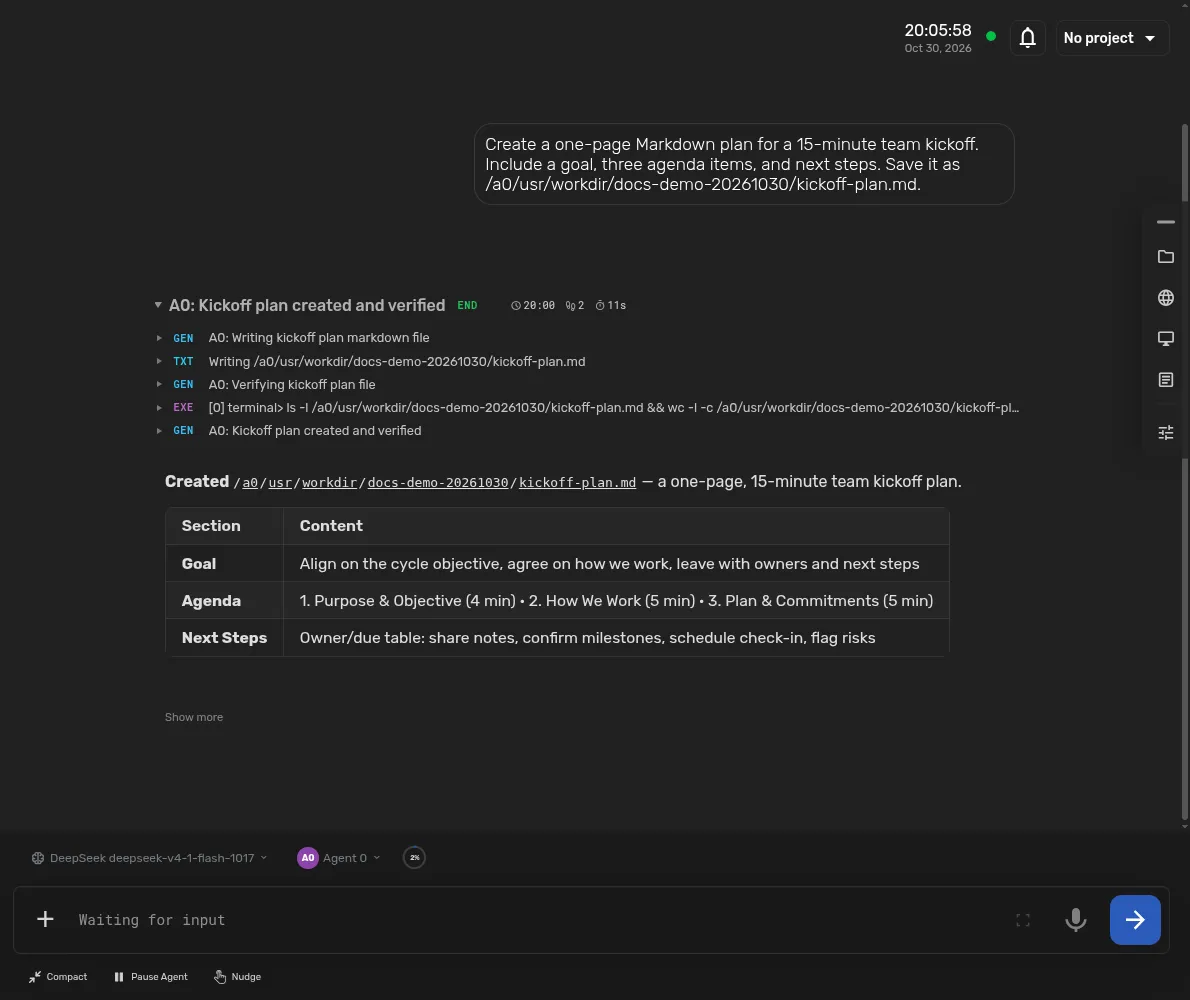
Agent Zero steht unter MIT-Lizenz und ist das älteste Projekt in diesem Ranking, mit Releases seit Juni 2024; v2.11 bis v2.15 erschienen zwischen Ende August und Anfang November 2026. Sein Community-Plugin-Hub umfasst über 200 Plugins.
Zwei Dinge sollten Sie über die Organisation wissen: Es ist ein kleines tschechisches Unternehmen, und das Projekt betreibt einen Token-gestakten Modell-Proxy für Inhaber seines Krypto-Tokens A0T (Details). Sie können diesen Proxy ignorieren und jeden beliebigen Anbieter oder ein lokales Modell verwenden.
6. Rakazo
Rakazo, das wir selbst entwickeln, steht unter Apache-2.0 und lässt sich vollständig selbst hosten. Der offene Code steht neben kostenpflichtigen gehosteten Plänen, die einen Cloud-Computer hinzufügen; bei der Unabhängigkeit ist es also in derselben Position wie Hermes Agent. Es erfüllt jeden Punkt der Checkliste, ist aber jünger und bezeichnet sich selbst als Beta. Siehe den Rakazo-Test.


7. NanoClaw
NanoClaw steht unter MIT-Lizenz und hat eine bewusst winzige Codebasis: ein Host-Prozess und eine Handvoll Dateien. Damit ist es der am besten lesbare Agent hier. Bei der Offenheit landet es auf dem letzten Platz, weil es auf Anthropics Claude Agent SDK aufbaut und für jede Anpassung Claude Code voraussetzt. In der Praxis ist es damit an ein proprietäres Tool gebunden, auch wenn sich pro Agent andere Anbieter hinzufügen lassen.

Lizenzen auf einen Blick
| Lizenz | Agenten |
|---|---|
| MIT | OpenClaw, Hermes Agent, nanobot, Agent Zero, NanoClaw |
| MIT oder Apache-2.0 | ZeroClaw |
| Apache-2.0 | Rakazo |
Alle erlauben es, den Code auszuführen, zu ändern und weiterzugeben, auch kommerziell. Das Modell, das Sie anschließen, ist eine andere Frage: Lokale Open-Weight-Modelle haben eigene Lizenzen und gehostete Anbieter eigene Nutzungsbedingungen.
Für andere Blickwinkel siehe die besten lokalen KI-Agenten und OpenClaw-Alternativen.
Bestenlisten
Free, MIT-licensed personal AI agent that runs on your own computer and takes orders from WhatsApp, Telegram, iMessage, Slack and 20+ other chat apps.
The biggest ecosystem and every chat app, but sandboxing is off and telemetry is on by default.
OpenClaw öffnenStärken
- Free and MIT licensed, with no paid tier
- Runs on your own hardware, and state, memory and credentials stay there
- Works in 29 chat channels, including WhatsApp, Telegram, iMessage, Slack, Discord and Microsoft Teams
- Model-agnostic: 64 model and media providers, plus local models
- Large ecosystem of skills and 142 official plugins, and very active development
Schwächen
- Model costs are on you and can run high: testers and users have reported spending over $100 in a day with expensive models
- Sandboxing is off by default and the agent can run commands on the host unless you turn on approvals
- Setup and upkeep expect comfort with the command line; maintainers warn it is risky for non-technical users
- Broad access to email, messages and the system makes prompt injection and malicious third-party skills a real risk
Free, MIT-licensed AI agent from Nous Research that runs on your own machine or server, learns reusable skills, and chats with you on Telegram, Slack and more.
MIT licensed, no telemetry and lives in your chat apps, but commands aren't sandboxed by default.
Hermes Agent öffnenStärken
- Free and MIT licensed, and runs on hardware you control
- Writes and refines its own skills from experience, on top of persistent memory and cross-session search
- One gateway for 20+ chat platforms, including Telegram, Discord, Slack, WhatsApp, Signal and email
- Run several separate agents as profiles, each with its own model, memory and skills, and let them talk in group chats
- Model-agnostic, with a one-command import from OpenClaw
Schwächen
- Setup expects comfort with the command line and with running your own server
- Model costs are on you unless you use free models, and hosted web search, images and speech need a paid Nous Portal plan or your own keys
- iMessage needs a separate BlueBubbles server on a Mac
- No native mobile app; Android support is a command-line install through Termux
Free, MIT-licensed personal AI agent in Python with a browser UI and terminal app, scheduled tasks, memory, and chat on Telegram, Discord, Slack and more.
Small, readable Python with a good web UI and no telemetry, but shell commands aren't sandboxed by default.
nanobot öffnenStärken
- Free and MIT licensed, with a small Python core that is meant to be read and modified
- Polished bundled WebUI with projects, file diffs, an MCP app catalog and an automations calendar, plus a terminal UI
- Many chat channels, including Telegram, Discord, Slack, WhatsApp, WeChat, Feishu, Teams, Matrix and email
- Scheduled automations, long-running goals and a heartbeat that reports only useful results to your last chat
- Works with local models through Ollama, vLLM or LM Studio
Schwächen
- Shell commands are not sandboxed by default; the bubblewrap or macOS Seatbelt sandbox must be turned on, and Windows has none
- Model costs are on you, and voice messages need a separate transcription provider such as Groq or OpenAI
- No native mobile or desktop app; on a phone you use the WebUI in a browser or a chat app
- Missed scheduled runs are not replayed and interrupted subagent tasks are not relaunched after a restart
Personal AI agent in one Rust binary, MIT or Apache-2.0, with local or cloud models, 30+ channels, approval gates and an OS sandbox on by default.
Meets every check: one Rust binary, approval gates and an OS sandbox on by default, no telemetry, local models.
ZeroClaw öffnenStärken
- Safe defaults: the recommended profile asks before medium-risk actions, blocks high-risk ones, keeps files in the workspace and runs tools in an OS sandbox
- One small Rust binary with one config file, running on macOS, Linux, Windows and boards like a Raspberry Pi
- More than 30 channels, plus a web dashboard for chat, memory, config and cron
- Provider fallback chains, local models through Ollama, and cryptographic receipts for tool calls
- States plainly that it sends no telemetry and needs no cloud account or license server
Schwächen
- Slack, iMessage, Signal and several other channels are not in the standard release; you build from source with extra features to get them
- `zeroclaw quickstart` only sets up the model provider; channels and risk profiles mean editing the TOML config file
- The Docker sandbox backend isn't picked automatically under the default native runtime
- Model costs are on you
Free, MIT-licensed AI agent that runs in its own Docker Linux workspace with a terminal, browser and desktop apps, and chats on Telegram and WhatsApp.
Runs in its own Docker container with local models, but sends telemetry by default.
Agent Zero öffnenStärken
- Free and MIT licensed, with frequent releases (v2.11 to v2.15 between late August and early November 2026)
- The agent works in its own Linux workspace with a terminal, browser, desktop apps and LibreOffice, isolated from your computer unless you grant host access
- Web search runs through a local SearXNG instance, and speech-to-text and text-to-speech can run locally
- Projects keep memory, files, secrets, instructions and model choices separate per job, with workspace snapshots you can roll back
- Built-in Telegram, WhatsApp and email channels, a scheduler, MCP and a community Plugin Hub with 200+ plugins
Schwächen
- Needs Docker, and the container image is a full Linux desktop environment rather than a small service
- No built-in image generation; the docs show teaching it an image API yourself
- By default it checks for updates with Agent Zero's server, sending your version and a hashed instance ID
- Code runs in the same container as Agent Zero itself today; per-task sandboxes are only a v3 prototype
- WhatsApp works by linking a phone account through a Baileys bridge, which needs Node.js, rather than the official WhatsApp Business API
Open-source, self-hostable platform for persistent AI bots that each get a job, a computer, memory and routines, using the model you choose.
Our own product. Meets every check: Apache-2.0, sandboxed bot computers, no telemetry by default, any model you connect.
Rakazo öffnenStärken
- Open source (Apache-2.0) and fully self-hostable, including with local models
- Choice of model per bot, including existing Claude or ChatGPT subscriptions
- Bots keep working on schedules and triggers with their own cloud computer
- Approval controls over which actions a bot may take on its own
Schwächen
- Still in beta, with frequent releases
- You supply and pay for the model on the hosted plans, unless you buy Rakazo credits
- Telegram, WhatsApp and iMessage/SMS are only available when self-hosted
- More setup than a single chat app
Small, MIT-licensed OpenClaw alternative that runs each agent in its own Docker container and chats with you on WhatsApp, Telegram, Slack, Discord and more.
Every agent in its own container and a tiny codebase, but tied to Claude Code and sends setup diagnostics by default.
NanoClaw öffnenStärken
- Every agent runs in its own Docker container and sees only the folders you mount, so shell access stays off your host
- Small codebase (one host process and a handful of files) that you customize by having Claude Code edit your fork
- Agents never hold raw API keys: outbound calls go through a credential gateway with per-agent policies and rate limits
- Many chat channels, including WhatsApp, Telegram, Slack, Discord, iMessage, Teams, Matrix and email, with one or several agents per channel
- Scheduled tasks with optional script gates that skip waking the agent when there's nothing to do
Schwächen
- Built around Claude and Claude Code: customizing, debugging and adding channels all go through Claude Code
- Sends anonymous setup diagnostics unless you set NANOCLAW_NO_DIAGNOSTICS=1
- No config files by design, so every change means editing code in your own fork
- Needs Docker, and Windows only works through WSL2
Funktionen
| OpenClaw | Hermes Agent | nanobot | ZeroClaw | Agent Zero | Rakazo | NanoClaw | |
|---|---|---|---|---|---|---|---|
| Websuche | Ja | Ja | Ja | Ja | Ja | Ja | Ja |
| Bilderzeugung | Ja | Ja | Ja | Ja | Nein | Ja | Unbekannt |
| Sprachmodus | Ja | Ja | Ja | Ja | Ja | Ja | Unbekannt |
| Datei-Uploads | Ja | Ja | Ja | Ja | Ja | Ja | Ja |
| Gedächtnis | Ja | Ja | Ja | Ja | Ja | Ja | Ja |
| Erledigt Aufgaben für dich | Ja | Ja | Ja | Ja | Ja | Ja | Ja |
| App-Integrationen | Ja | Ja | Ja | Ja | Ja | Ja | Ja |
| Arbeitet selbstständig | Ja | Ja | Ja | Ja | Ja | Ja | Ja |
| Meldet sich von selbst | Ja | Ja | Ja | Ja | Ja | Ja | Ja |
| Mehrere Bots möglich | Ja | Ja | Ja | Ja | Ja | Ja | Ja |
Quellen
OpenClaw
- OpenClaw homepage and Foundation section
- OpenClaw integrations: channels, providers and plugins
- openclaw/openclaw on GitHub (MIT, v2026.11.1)
- OpenClaw docs: Sandboxing (off by default)
- Wikipedia: OpenClaw
- Notebookcheck: OpenClaw can burn through hundreds of dollars per day
- OpenClaw docs: Memory overview
- OpenClaw docs: Automations
- OpenClaw docs: Chat channels
- OpenClaw docs: iMessage
- OpenClaw docs: Heartbeat, now a default Proactive check job
- OpenClaw docs: Multi-agent routing
- OpenClaw docs: Platforms (macOS, Windows, Linux, iOS and Android apps)
- OpenClaw docs: Tools (exec, browser, web search)
- OpenClaw docs: Audio and voice notes (inbound transcription)
- OpenClaw docs: Image and media support (inbound media)
- OpenClaw docs: Install (system requirements, installer script, npm, desktop apps, Docker)
- OpenClaw docs: One-click deploy on Railway
- OpenClaw docs: Usage telemetry and update checks (on by default, feature statistics opt-in)
- OpenClaw docs: Ollama provider (local models)
Hermes Agent
- NousResearch/hermes-agent on GitHub (MIT, v0.23.0)
- Hermes Agent homepage and Nous Portal pricing
- Hermes Agent documentation
- Hermes Agent docs: Profiles, running multiple agents
- Hermes Agent docs: Bot Mode
- Hermes Agent docs: Voice mode
- Hermes Agent docs: Vision and image paste
- Hermes Agent docs: iMessage via BlueBubbles
- Nous Research on X: Meet Hermes Agent (February 25, 2026)
- Hermes Agent docs: Session heartbeats and cron watchdogs
- Hermes Agent docs: FAQ (Is my data sent anywhere?)
- Hermes Agent docs: Installation (desktop packages, install script, Docker)
- Hermes Agent docs: Platform support (no Linux desktop package; PyPI installs unsupported)
- Hermes Agent docs: Docker setup
- Hermes Agent docs: Configuration (terminal backend defaults to local)
- Hermes Agent docs: Security (approval modes, optional container isolation)
- Hermes Agent docs: Local models
- Hermes Agent example config (shared metrics off by default)
nanobot
- HKUDS/nanobot on GitHub (MIT, v0.4.1, README)
- nanobot documentation
- nanobot release archive (officially launched February 2, 2026)
- nanobot docs: Chat apps
- nanobot docs: Providers and models (Ollama, vLLM, LM Studio)
- nanobot docs: Configuration (security, exec sandbox off by default, transcription, Langfuse)
- nanobot docs: Automations and heartbeat
- nanobot docs: Concepts (heartbeat delivery, subagent recovery)
- nanobot docs: Memory and Dream
- nanobot docs: Multiple instances
- nanobot docs: Deployment (Docker, services, Render)
- nanobot source: skills installer runs with DISABLE_TELEMETRY
ZeroClaw
- zeroclaw-labs/zeroclaw on GitHub (MIT OR Apache-2.0, v0.8.7, README)
- ZeroClaw website
- ZeroClaw docs: Sandboxing
- ZeroClaw source: risk presets (Balanced, recommended, has the sandbox on)
- ZeroClaw docs: Channels overview (default and standard release bundles)
- ZeroClaw docs: You own it (no telemetry)
- ZeroClaw docs: Docker and containers
- ZeroClaw source: tools (image generation, screenshot, web)
Agent Zero
- agent0ai/agent-zero on GitHub (MIT, README, safety model)
- Agent Zero releases (v0.2 in June 2024 to v2.15 on November 1, 2026)
- Agent Zero homepage
- Agent Zero docs: Installation (Launcher, A0 Install, Docker, local models)
- Agent Zero docs: VPS deployment (hardware requirements)
- Agent Zero model provider list
- Agent Zero update check code (version and hashed ID sent to api.agent-zero.ai)
- Agent Zero built-in Telegram integration plugin
- Agent Zero built-in WhatsApp integration plugin
- Agent Zero built-in plugins (scheduler, notify user, email, SearXNG search, Whisper STT, Kokoro TTS)
- Agent Zero docs: Memory guide
- Agent Zero docs: Agent Profiles
- Agent Zero docs: API integration (adding image generation yourself)
- Agent Zero v3: A Sneak Peek Inside the Sandbox (August 17, 2026)
- Agent Zero LLM API (Venice.ai proxy for A0T token stakers)
Rakazo
- Rakazo homepage
- Rakazo pricing
- Rakazo privacy policy
- Rakazo on GitHub (README and license)
- Rakazo changelog
- Rakazo releases
- Rakazo docs: Image and video generation
- Rakazo docs: Memory
- Rakazo docs: Connect apps
- Rakazo docs: Routines
- Rakazo docs: Chat apps
- Rakazo docs: Messaging apps (self-hosting)
- Rakazo docs: Bots and chats (add another bot, bot templates)
- Rakazo docs: Groups (several bots in one chat)
- Rakazo docs: Mobile app (notifications)
- Rakazo privacy policy (updated Sep 14, 2026)
- Rakazo privacy policy source on GitHub
- Rakazo docs: Logs and monitoring (product analytics off by default)
- Rakazo docs: Desktop app (run locally in Docker, updates)
- Rakazo docs: Docker computers
- Rakazo docs: Self-hosted models (Ollama, LM Studio)
- Rakazo Railway template setup guide