Najlepsi open source'owi agenci AI i osobiści asystenci AI
Siedmiu open source'owych agentów AI porównanych pod kątem licencji, społeczności, dojrzałości i realnej otwartości: od OpenClaw i Hermes Agent po małe projekty.
W skrócie
| Bot | Licencja | Komunikatory | |||||
|---|---|---|---|---|---|---|---|
| OpenClaw | MIT | 394,2 tys. | Tak | Nie | Telegram, WhatsApp, iMessage, Discord, Slack | Za darmo | |
| Hermes Agent | MIT | 261,7 tys. | Tak | Nie | Telegram, WhatsApp, iMessage, Discord, Slack | Od 20 USD/mies. | |
| nanobot | MIT | 49,9 tys. | Tak | Nie | Telegram, WhatsApp, Discord, Slack | Za darmo | |
| ZeroClaw | MIT OR Apache-2.0 | 33,3 tys. | Tak | Tak | Telegram, WhatsApp, Discord | Za darmo | |
| Agent Zero | MIT | 19,8 tys. | Tak | Tak | Telegram, WhatsApp | Za darmo | |
| Rakazo | Apache-2.0 | 7,5 tys. | Tak | Tak | Telegram, WhatsApp, iMessage, Slack | Od 10 USD/mies. | |
| NanoClaw | MIT | 31,1 tys. | Tak | Tak | Telegram, WhatsApp, iMessage, Discord, Slack | Za darmo |


Lista kontrolna
| OpenClaw | Hermes Agent | nanobot | ZeroClaw | Agent Zero | Rakazo | NanoClaw | |
|---|---|---|---|---|---|---|---|
| Licencja open source | Tak | Tak | Tak | Tak | Tak | Tak | Tak |
| Działa z modelami lokalnymi | Tak | Tak | Tak | Tak | Tak | Tak | Tak |
| Domyślnie w sandboksie | Nie | Nie | Nie | Tak | Tak | Tak | Tak |
| Domyślnie bez telemetrii | Nie | Tak | Tak | Tak | Nie | Tak | Nie |
| Działa w twoich komunikatorach | Tak | Tak | Tak | Tak | Tak | Tak | Tak |
| Pracuje, gdy cię nie ma | Tak | Tak | Tak | Tak | Tak | Tak | Tak |
„Open source” oznacza w tej kategorii bardzo różne rzeczy. Niektóre projekty mają licencję MIT i żadnej firmy, która coś na nich sprzedaje; inne to otwarty kod obok płatnej usługi hostowanej; kilka jest otwartych, ale ledwo utrzymywanych. Ten ranking dotyczy właśnie części open source: na co pozwala licencja, kto stoi za kodem i czy projekt za rok nadal będzie się rozwijał.
Jak powstał ranking
Wszystkie siedem projektów jest open source, można je hostować samodzielnie i wszystkie działają z lokalnymi modelami. Braliśmy pod uwagę:
- Licencję. Licencje permisywne (MIT, Apache-2.0) stawiamy dla większości czytelników wyżej niż copyleft, bo pozwalają modyfikować i redystrybuować kod bez udostępniania własnych zmian.
- Niezależność. Organizacja non-profit albo laboratorium badawcze, które nic nie sprzedaje, to mocniejsza gwarancja niż dostawca, którego otwarty kod napędza płatny plan, choć samo w sobie żadne z nich nie jest problemem.
- Społeczność i dojrzałość. Wielkość projektu, tempo wydań i to, czy opiekunowie określają go jako alfę, betę czy wersję stabilną.
- Łatwość modyfikacji. Ile kodu trzeba przeczytać, żeby coś zmienić.
- Lista kontrolna serwisu (tabela powyżej): sandboxing, telemetria, aplikacje czatowe i praca w tle nadal się liczą, tylko z mniejszą wagą niż w naszym rankingu agentów do samodzielnego hostowania.
Pominęliśmy Khoj, który ma licencję AGPL-3.0 i nie miał wydania od marca 2026, oraz OpenFang, w którym od maja 2026 nie pojawił się żaden commit.
1. OpenClaw
OpenClaw nie bez powodu jest domyślnym open source’owym agentem AI. Ma licencję MIT, nie ma płatnego planu ani usługi hostowanej, a opiekuje się nim fundacja non-profit OpenClaw Foundation (strona główna). To także zdecydowanie największa społeczność na tej liście (zob. tabelę), ze 142 oficjalnymi wtyczkami i dużym ekosystemem umiejętności (skills).
Open source nie oznacza domyślnie bezpiecznego: sandboxing jest wyłączony, a codzienne sprawdzanie aktualizacji włączone. Przed podłączeniem go do prawdziwych kont warto przeczytać Czy OpenClaw jest bezpieczny?, a na początek czym jest OpenClaw.

2. Hermes Agent
Hermes Agent ma licencję MIT i jest drugim co do wielkości projektem w zestawieniu. Z dwóch największych jest najbardziej otwarty w kwestii danych: domyślnie bez telemetrii, a wszystko zostaje w ~/.hermes, chyba że jako dostawcę modelu wybierze się Nous Portal. Jego znakiem rozpoznawczym jest to, że sam pisze i dopracowuje własne umiejętności wielokrotnego użytku.
Pod względem niezależności zajmuje drugie miejsce: Nous Research obok darmowego kodu sprzedaje subskrypcje Nous Portal od $20 miesięcznie. Nigdy nie jest ona potrzebna, ale hostowane wyszukiwanie w sieci, obrazy i mowa wymagają albo planu, albo własnych kluczy. Więcej w artykule czym jest Hermes Agent.

3. nanobot
nanobot pochodzi z Data Intelligence Lab Uniwersytetu w Hongkongu i został zbudowany tak, by dało się go przeczytać: mały rdzeń w Pythonie, licencja MIT i żadnej usługi hostowanej do sprzedania. Ma Python SDK i API zgodne z OpenAI, więc nadaje się też jako baza dla własnego agenta. Dołączony WebUI należy do lepszych na liście.
Kompromis polega na tym, że polecenia powłoki domyślnie nie są uruchamiane w sandboksie.

4. ZeroClaw
ZeroClaw ma podwójną licencję MIT lub Apache-2.0 i jest dostarczany jako pojedynczy plik binarny w Rust. Według samej listy kontrolnej wypada lepiej niż wszystko powyżej: domyślnie działa w sandboksie i nie ma telemetrii. Jest tu czwarty, bo jego społeczność jest dużo mniejsza niż społeczności OpenClaw i Hermes Agent, a Rust to wyższy próg wejścia niż Python czy TypeScript, jeśli planuje się zmiany w kodzie.

5. Agent Zero
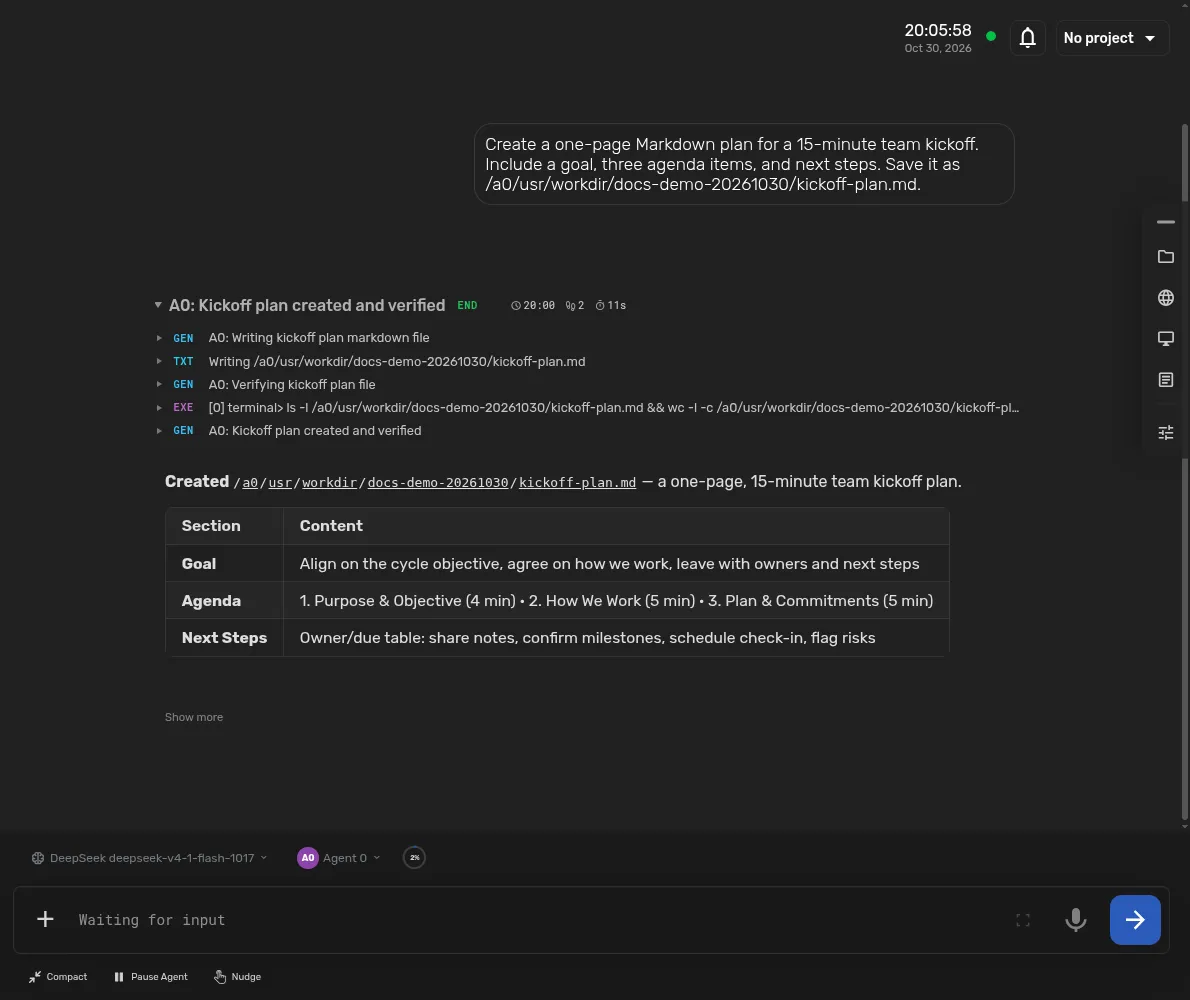
Agent Zero ma licencję MIT i jest najstarszym projektem w rankingu: wydania pojawiają się od czerwca 2024, a wersje od v2.11 do v2.15 wyszły między końcem sierpnia a początkiem listopada 2026. Jego społecznościowy Plugin Hub ma ponad 200 wtyczek.
O organizacji warto wiedzieć dwie rzeczy: to mała czeska firma, a projekt prowadzi proxy do modeli oparte na stakingu tokenów dla posiadaczy swojego kryptotokena A0T (szczegóły). Można to proxy zignorować i użyć dowolnego dostawcy lub lokalnego modelu.
6. Rakazo
Rakazo, które tworzymy, ma licencję Apache-2.0 i można je w pełni hostować samodzielnie. Otwarty kod istnieje obok płatnych planów hostowanych, które dodają komputer w chmurze, więc pod względem niezależności jest w tej samej sytuacji co Hermes Agent. Spełnia każdy punkt listy kontrolnej, ale jest młodsze i określa się jako beta. Zob. recenzję Rakazo.


7. NanoClaw
NanoClaw ma licencję MIT i celowo maleńki kod: jeden proces hosta i kilka plików. Dzięki temu to najłatwiejszy do przeczytania agent w zestawieniu. Pod względem otwartości jest ostatni, bo zbudowano go na Claude Agent SDK od Anthropic i każda modyfikacja zakłada użycie Claude Code, więc w praktyce jest związany z jednym zamkniętym narzędziem, mimo że dla poszczególnych agentów można dodać innych dostawców.

Licencje w skrócie
| Licencja | Agenci |
|---|---|
| MIT | OpenClaw, Hermes Agent, nanobot, Agent Zero, NanoClaw |
| MIT lub Apache-2.0 | ZeroClaw |
| Apache-2.0 | Rakazo |
Wszystkie pozwalają uruchamiać, modyfikować i redystrybuować kod, także komercyjnie. Podłączony model to osobna kwestia: lokalne modele z otwartymi wagami mają własne licencje, a dostawcy hostowani własne warunki.
Inne spojrzenie dają zestawienia najlepszych lokalnych agentów AI oraz alternatyw dla OpenClaw.
Najlepsze wybory
Free, MIT-licensed personal AI agent that runs on your own computer and takes orders from WhatsApp, Telegram, iMessage, Slack and 20+ other chat apps.
The biggest ecosystem and every chat app, but sandboxing is off and telemetry is on by default.
Przejdź do OpenClawMocne strony
- Free and MIT licensed, with no paid tier
- Runs on your own hardware, and state, memory and credentials stay there
- Works in 29 chat channels, including WhatsApp, Telegram, iMessage, Slack, Discord and Microsoft Teams
- Model-agnostic: 64 model and media providers, plus local models
- Large ecosystem of skills and 142 official plugins, and very active development
Słabe strony
- Model costs are on you and can run high: testers and users have reported spending over $100 in a day with expensive models
- Sandboxing is off by default and the agent can run commands on the host unless you turn on approvals
- Setup and upkeep expect comfort with the command line; maintainers warn it is risky for non-technical users
- Broad access to email, messages and the system makes prompt injection and malicious third-party skills a real risk
Free, MIT-licensed AI agent from Nous Research that runs on your own machine or server, learns reusable skills, and chats with you on Telegram, Slack and more.
MIT licensed, no telemetry and lives in your chat apps, but commands aren't sandboxed by default.
Przejdź do Hermes AgentMocne strony
- Free and MIT licensed, and runs on hardware you control
- Writes and refines its own skills from experience, on top of persistent memory and cross-session search
- One gateway for 20+ chat platforms, including Telegram, Discord, Slack, WhatsApp, Signal and email
- Run several separate agents as profiles, each with its own model, memory and skills, and let them talk in group chats
- Model-agnostic, with a one-command import from OpenClaw
Słabe strony
- Setup expects comfort with the command line and with running your own server
- Model costs are on you unless you use free models, and hosted web search, images and speech need a paid Nous Portal plan or your own keys
- iMessage needs a separate BlueBubbles server on a Mac
- No native mobile app; Android support is a command-line install through Termux
Free, MIT-licensed personal AI agent in Python with a browser UI and terminal app, scheduled tasks, memory, and chat on Telegram, Discord, Slack and more.
Small, readable Python with a good web UI and no telemetry, but shell commands aren't sandboxed by default.
Przejdź do nanobotMocne strony
- Free and MIT licensed, with a small Python core that is meant to be read and modified
- Polished bundled WebUI with projects, file diffs, an MCP app catalog and an automations calendar, plus a terminal UI
- Many chat channels, including Telegram, Discord, Slack, WhatsApp, WeChat, Feishu, Teams, Matrix and email
- Scheduled automations, long-running goals and a heartbeat that reports only useful results to your last chat
- Works with local models through Ollama, vLLM or LM Studio
Słabe strony
- Shell commands are not sandboxed by default; the bubblewrap or macOS Seatbelt sandbox must be turned on, and Windows has none
- Model costs are on you, and voice messages need a separate transcription provider such as Groq or OpenAI
- No native mobile or desktop app; on a phone you use the WebUI in a browser or a chat app
- Missed scheduled runs are not replayed and interrupted subagent tasks are not relaunched after a restart
Personal AI agent in one Rust binary, MIT or Apache-2.0, with local or cloud models, 30+ channels, approval gates and an OS sandbox on by default.
Meets every check: one Rust binary, approval gates and an OS sandbox on by default, no telemetry, local models.
Przejdź do ZeroClawMocne strony
- Safe defaults: the recommended profile asks before medium-risk actions, blocks high-risk ones, keeps files in the workspace and runs tools in an OS sandbox
- One small Rust binary with one config file, running on macOS, Linux, Windows and boards like a Raspberry Pi
- More than 30 channels, plus a web dashboard for chat, memory, config and cron
- Provider fallback chains, local models through Ollama, and cryptographic receipts for tool calls
- States plainly that it sends no telemetry and needs no cloud account or license server
Słabe strony
- Slack, iMessage, Signal and several other channels are not in the standard release; you build from source with extra features to get them
- `zeroclaw quickstart` only sets up the model provider; channels and risk profiles mean editing the TOML config file
- The Docker sandbox backend isn't picked automatically under the default native runtime
- Model costs are on you
Free, MIT-licensed AI agent that runs in its own Docker Linux workspace with a terminal, browser and desktop apps, and chats on Telegram and WhatsApp.
Runs in its own Docker container with local models, but sends telemetry by default.
Przejdź do Agent ZeroMocne strony
- Free and MIT licensed, with frequent releases (v2.11 to v2.15 between late August and early November 2026)
- The agent works in its own Linux workspace with a terminal, browser, desktop apps and LibreOffice, isolated from your computer unless you grant host access
- Web search runs through a local SearXNG instance, and speech-to-text and text-to-speech can run locally
- Projects keep memory, files, secrets, instructions and model choices separate per job, with workspace snapshots you can roll back
- Built-in Telegram, WhatsApp and email channels, a scheduler, MCP and a community Plugin Hub with 200+ plugins
Słabe strony
- Needs Docker, and the container image is a full Linux desktop environment rather than a small service
- No built-in image generation; the docs show teaching it an image API yourself
- By default it checks for updates with Agent Zero's server, sending your version and a hashed instance ID
- Code runs in the same container as Agent Zero itself today; per-task sandboxes are only a v3 prototype
- WhatsApp works by linking a phone account through a Baileys bridge, which needs Node.js, rather than the official WhatsApp Business API
Open-source, self-hostable platform for persistent AI bots that each get a job, a computer, memory and routines, using the model you choose.
Our own product. Meets every check: Apache-2.0, sandboxed bot computers, no telemetry by default, any model you connect.
Przejdź do RakazoMocne strony
- Open source (Apache-2.0) and fully self-hostable, including with local models
- Choice of model per bot, including existing Claude or ChatGPT subscriptions
- Bots keep working on schedules and triggers with their own cloud computer
- Approval controls over which actions a bot may take on its own
Słabe strony
- Still in beta, with frequent releases
- You supply and pay for the model on the hosted plans, unless you buy Rakazo credits
- Telegram, WhatsApp and iMessage/SMS are only available when self-hosted
- More setup than a single chat app
Small, MIT-licensed OpenClaw alternative that runs each agent in its own Docker container and chats with you on WhatsApp, Telegram, Slack, Discord and more.
Every agent in its own container and a tiny codebase, but tied to Claude Code and sends setup diagnostics by default.
Przejdź do NanoClawMocne strony
- Every agent runs in its own Docker container and sees only the folders you mount, so shell access stays off your host
- Small codebase (one host process and a handful of files) that you customize by having Claude Code edit your fork
- Agents never hold raw API keys: outbound calls go through a credential gateway with per-agent policies and rate limits
- Many chat channels, including WhatsApp, Telegram, Slack, Discord, iMessage, Teams, Matrix and email, with one or several agents per channel
- Scheduled tasks with optional script gates that skip waking the agent when there's nothing to do
Słabe strony
- Built around Claude and Claude Code: customizing, debugging and adding channels all go through Claude Code
- Sends anonymous setup diagnostics unless you set NANOCLAW_NO_DIAGNOSTICS=1
- No config files by design, so every change means editing code in your own fork
- Needs Docker, and Windows only works through WSL2
Funkcje
| OpenClaw | Hermes Agent | nanobot | ZeroClaw | Agent Zero | Rakazo | NanoClaw | |
|---|---|---|---|---|---|---|---|
| Wyszukiwanie w sieci | Tak | Tak | Tak | Tak | Tak | Tak | Tak |
| Generowanie obrazów | Tak | Tak | Tak | Tak | Nie | Tak | Nieznane |
| Tryb głosowy | Tak | Tak | Tak | Tak | Tak | Tak | Nieznane |
| Przesyłanie plików | Tak | Tak | Tak | Tak | Tak | Tak | Tak |
| Pamięć | Tak | Tak | Tak | Tak | Tak | Tak | Tak |
| Wykonuje zadania za ciebie | Tak | Tak | Tak | Tak | Tak | Tak | Tak |
| Integracje z aplikacjami | Tak | Tak | Tak | Tak | Tak | Tak | Tak |
| Działa samodzielnie | Tak | Tak | Tak | Tak | Tak | Tak | Tak |
| Pisze pierwszy | Tak | Tak | Tak | Tak | Tak | Tak | Tak |
| Wiele botów | Tak | Tak | Tak | Tak | Tak | Tak | Tak |
Źródła
OpenClaw
- OpenClaw homepage and Foundation section
- OpenClaw integrations: channels, providers and plugins
- openclaw/openclaw on GitHub (MIT, v2026.11.1)
- OpenClaw docs: Sandboxing (off by default)
- Wikipedia: OpenClaw
- Notebookcheck: OpenClaw can burn through hundreds of dollars per day
- OpenClaw docs: Memory overview
- OpenClaw docs: Automations
- OpenClaw docs: Chat channels
- OpenClaw docs: iMessage
- OpenClaw docs: Heartbeat, now a default Proactive check job
- OpenClaw docs: Multi-agent routing
- OpenClaw docs: Platforms (macOS, Windows, Linux, iOS and Android apps)
- OpenClaw docs: Tools (exec, browser, web search)
- OpenClaw docs: Audio and voice notes (inbound transcription)
- OpenClaw docs: Image and media support (inbound media)
- OpenClaw docs: Install (system requirements, installer script, npm, desktop apps, Docker)
- OpenClaw docs: One-click deploy on Railway
- OpenClaw docs: Usage telemetry and update checks (on by default, feature statistics opt-in)
- OpenClaw docs: Ollama provider (local models)
Hermes Agent
- NousResearch/hermes-agent on GitHub (MIT, v0.23.0)
- Hermes Agent homepage and Nous Portal pricing
- Hermes Agent documentation
- Hermes Agent docs: Profiles, running multiple agents
- Hermes Agent docs: Bot Mode
- Hermes Agent docs: Voice mode
- Hermes Agent docs: Vision and image paste
- Hermes Agent docs: iMessage via BlueBubbles
- Nous Research on X: Meet Hermes Agent (February 25, 2026)
- Hermes Agent docs: Session heartbeats and cron watchdogs
- Hermes Agent docs: FAQ (Is my data sent anywhere?)
- Hermes Agent docs: Installation (desktop packages, install script, Docker)
- Hermes Agent docs: Platform support (no Linux desktop package; PyPI installs unsupported)
- Hermes Agent docs: Docker setup
- Hermes Agent docs: Configuration (terminal backend defaults to local)
- Hermes Agent docs: Security (approval modes, optional container isolation)
- Hermes Agent docs: Local models
- Hermes Agent example config (shared metrics off by default)
nanobot
- HKUDS/nanobot on GitHub (MIT, v0.4.1, README)
- nanobot documentation
- nanobot release archive (officially launched February 2, 2026)
- nanobot docs: Chat apps
- nanobot docs: Providers and models (Ollama, vLLM, LM Studio)
- nanobot docs: Configuration (security, exec sandbox off by default, transcription, Langfuse)
- nanobot docs: Automations and heartbeat
- nanobot docs: Concepts (heartbeat delivery, subagent recovery)
- nanobot docs: Memory and Dream
- nanobot docs: Multiple instances
- nanobot docs: Deployment (Docker, services, Render)
- nanobot source: skills installer runs with DISABLE_TELEMETRY
ZeroClaw
- zeroclaw-labs/zeroclaw on GitHub (MIT OR Apache-2.0, v0.8.7, README)
- ZeroClaw website
- ZeroClaw docs: Sandboxing
- ZeroClaw source: risk presets (Balanced, recommended, has the sandbox on)
- ZeroClaw docs: Channels overview (default and standard release bundles)
- ZeroClaw docs: You own it (no telemetry)
- ZeroClaw docs: Docker and containers
- ZeroClaw source: tools (image generation, screenshot, web)
Agent Zero
- agent0ai/agent-zero on GitHub (MIT, README, safety model)
- Agent Zero releases (v0.2 in June 2024 to v2.15 on November 1, 2026)
- Agent Zero homepage
- Agent Zero docs: Installation (Launcher, A0 Install, Docker, local models)
- Agent Zero docs: VPS deployment (hardware requirements)
- Agent Zero model provider list
- Agent Zero update check code (version and hashed ID sent to api.agent-zero.ai)
- Agent Zero built-in Telegram integration plugin
- Agent Zero built-in WhatsApp integration plugin
- Agent Zero built-in plugins (scheduler, notify user, email, SearXNG search, Whisper STT, Kokoro TTS)
- Agent Zero docs: Memory guide
- Agent Zero docs: Agent Profiles
- Agent Zero docs: API integration (adding image generation yourself)
- Agent Zero v3: A Sneak Peek Inside the Sandbox (August 17, 2026)
- Agent Zero LLM API (Venice.ai proxy for A0T token stakers)
Rakazo
- Rakazo homepage
- Rakazo pricing
- Rakazo privacy policy
- Rakazo on GitHub (README and license)
- Rakazo changelog
- Rakazo releases
- Rakazo docs: Image and video generation
- Rakazo docs: Memory
- Rakazo docs: Connect apps
- Rakazo docs: Routines
- Rakazo docs: Chat apps
- Rakazo docs: Messaging apps (self-hosting)
- Rakazo docs: Bots and chats (add another bot, bot templates)
- Rakazo docs: Groups (several bots in one chat)
- Rakazo docs: Mobile app (notifications)
- Rakazo privacy policy (updated Sep 14, 2026)
- Rakazo privacy policy source on GitHub
- Rakazo docs: Logs and monitoring (product analytics off by default)
- Rakazo docs: Desktop app (run locally in Docker, updates)
- Rakazo docs: Docker computers
- Rakazo docs: Self-hosted models (Ollama, LM Studio)
- Rakazo Railway template setup guide